
STCC creates 3D-printed heart models to enhance patient education at Baystate Health
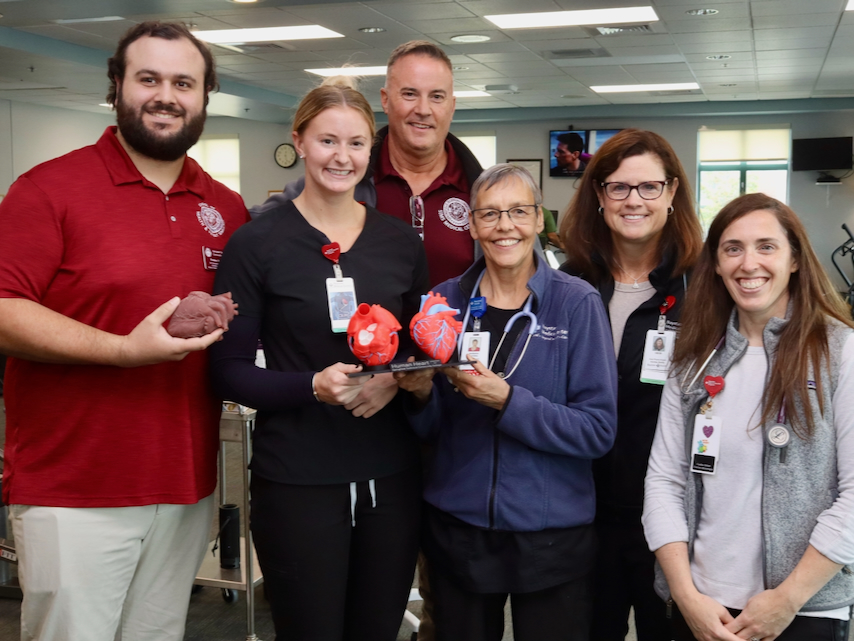
From left: Thad Texieria, STCC 3D print specialist; McKenzie Lyne, Baystate cardiac rehab tech; Andrew Lyne, STCC simulation coordinator; Barbara Eufemia, cardiac registered nurse (RN); Heidi Szalai, exercise physiologist; and Regina Krupczak, exercise physiologist.
SPRINGFIELD, Mass. – When Andrew Lyne saw an opportunity to help cardiac rehabilitation patients better understand their recovery, he turned to a resource at Springfield Technical Community College: the SIMS Medical Center Innovations Lab.
Lyne, patient informatics coordinator at STCC, had observed the educational sessions at Baystate Health's cardiac rehabilitation program. He recognized an opportunity to make those lessons more engaging and tangible through anatomical models patients could see and touch.
He knew the SIMS Medical Center Innovations Lab team was up for the task.
The team had already developed a variety of anatomical teaching tools, including models of kidneys, livers, and hand bones. Working with Simulation Coordinator Daniel Taibbi and other team members, Lyne proposed creating three different heart models for Baystate's cardiac rehabilitation program.
The resulting models will give cardiologists and rehabilitation staff new ways to explain heart anatomy, discuss medical procedures, and help patients better understand their recovery.
“Patients often have questions after their procedure, ranging from general to very specific,” said Patrick Schilling, regional manager of Cardiovascular Rehabilitation and Wellness at Baystate Health. “The models provided by STCC enhance our ability to deliver advanced patient education, both in one-on-one sessions and in our ‘How the Heart Works’ group class.”
The three models offer different ways for patients to explore the anatomy and function of the heart.
One is a multicolored plastic model that helps distinguish anatomical structures and illustrate the pathways of blood vessels. A second model opens along a central seam, allowing patients and clinicians to examine the heart's internal structures. Magnets hold the model together while allowing it to be opened and closed easily.
The third model is made from silicone, giving it a soft, squeezable texture that more closely resembles the feel of human tissue.
Together, the models provide different opportunities for hands-on learning.
The models provided by STCC enhance our ability to deliver advanced patient education, both in one-on-one sessions and in our ‘How the Heart Works’ group class.Patrick Schilling, Baystate Health
Clinicians can use them to identify the heart's atria, ventricles, and major coronary vessels, reinforcing information patients receive from surgeons, interventionalists, and cardiologists. The models can also help patients visualize the anatomy involved in a procedure and better understand how medical treatment affects the heart.
Schilling said the physical models are especially valuable for patients who learn best through visual and tactile experiences.
“These models provide tangible examples that patients can see, understand, and touch,” he said. “Using realistic models is more effective than handouts or verbal explanations, especially for visual and tactile learners.”
The models also offer an educational benefit for patients who speak English as an additional language. When used with interpreters, they provide a visual reference that can help clinicians communicate complex medical information more clearly.
For Taibbi, the project illustrates how SIMS Medical Center Innovations Lab can combine technical expertise, specialized equipment, and creative problem-solving to meet a partner's needs.
“One of the things we offer at our Innovations Lab is the ability to design, create, and manufacture items that we might otherwise have to purchase,” Taibbi said. “The advantage is not only the lower cost but also the ability to customize these items to meet the specific needs of our faculty and students.”
Creating the three hearts required a combination of 3D printing, design software, and specialized materials.
The two rigid plastic models were produced using polylactic acid, or PLA, a commonly used 3D-printing filament. The printers build the objects layer by layer, with software controlling the printing process, including the colors and structures.
The silicone heart required a more involved process. The team first printed a mold, then used silicone casting techniques to produce the finished model. The project also drew on expertise from the lab's moulage department, which uses specialized materials to create realistic simulated injuries and other medical training aids.
The model that opens presented its own engineering challenge: determining how to make the two halves separate easily while remaining securely closed when not in use. The team ultimately incorporated magnets into the design.
From initial concept to completion, the project took approximately 40 hours, Taibbi said.
The project builds on an existing relationship between STCC and Baystate Health, which provides clinical placements, internships, and shadowing opportunities for STCC students.
Schilling said the collaboration benefits both organizations: STCC students gain hands-on experience with a complex technical project, while Baystate receives new tools to strengthen patient education.
“As a teaching hospital, we value connections and educational partnerships within our community,” Schilling said. “This partnership benefits both organizations.”
The collaboration could also lead to more specialized educational models in the future.
Lyne has envisioned developing models that illustrate damage to heart muscle following a heart attack, for example, helping clinicians show patients where blood flow was compromised and explain why particular treatments or procedures were necessary.
Such customized models could help connect medical information more directly to a patient's individual experience.
“Baystate's healthcare professionals understand the challenges their patients face and have ideas for how to improve their care,” Taibbi said. “At STCC, we have the technology, resources, and expertise to help bring those ideas to life. This partnership allows us to combine our strengths and create solutions that make a meaningful difference for patients.”
Interested in applying to STCC? Visit stcc.edu/apply or call Admissions at (413) 755-3333.
About Springfield Technical Community College
STCC, the Commonwealth’s only technical community college, continues the pioneering legacy of the Springfield Armory with comprehensive and technical education in manufacturing, STEM, healthcare, business, social services, and the liberal arts. STCC’s highly regarded workforce, certificate, degree, and transfer programs are the most affordable in Springfield and provide opportunity for the vitality of Western Massachusetts. Founded in 1967, the College—a designated Hispanic-Serving Institution—seeks to close achievement gaps among students who traditionally face societal barriers. STCC supports students as they transform their lives through intellectual, cultural, and economic engagement while becoming thoughtful, committed, and socially responsible graduates.
MEDIA CONTACT:
Jim Danko, (413) 755-4812, jdanko@stcc.edu