
Virtual reality transforms nursing education at STCC
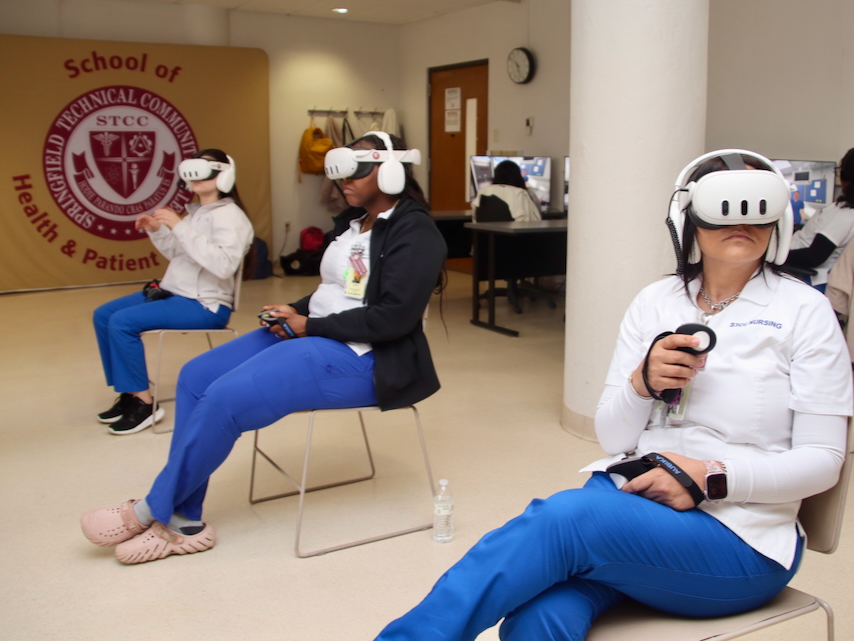
STCC nursing students use virtual reality tools in the classroom.
SPRINGFIELD, Mass. – A patient named Maria gasps for air. Her breathing is rapid, her oxygen levels dropping. The room feels urgent as alarms sound and vital signs begin to shift.
For a moment, it feels like a real medical emergency.
But the patient, “Maria,” is virtual – and for nursing students at Springfield Technical Community College, that’s the point.
Inside STCC’s Accelerated Nursing Program, students are using virtual reality technology powered by Oxford Medical Simulation (OMS) to step into high-pressure clinical scenarios. Wearing headsets, they assess patients, make decisions and intervene in real time, building skills that are difficult to replicate in traditional settings.
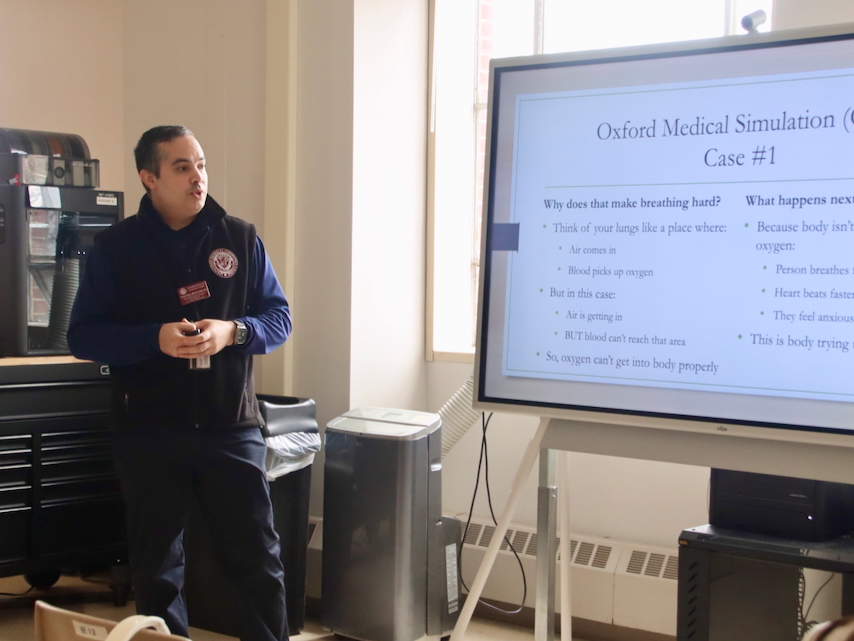
Ricardo Borgos, assistant professor of nursing and coordinator of the Accelerated Nursing Program, uses virtual reality technology powered by Oxford Medical Simulation.
“It’s a safe, realistic practice,” said Ricardo Borgos, assistant professor of nursing and coordinator of the Accelerated Nursing Program. “You practice real patient case scenarios and decision-making in a risk-free virtual environment.”
Designed for licensed practical nurses, paramedics and military medics, the 12-month accelerated program is rigorous and fast-paced. Virtual reality adds another layer, giving students access to critical situations they may not encounter during clinical placements.
Christopher Scott, dean of the School of Health and Patient Simulation, said the college is intentional about investing in forward-thinking approaches to education.
“At STCC, we are committed to supporting innovative teaching and learning strategies that meet students where they are and prepare them for the realities of today’s healthcare environment,” Scott said. “Embracing new technologies like virtual reality ensures our students are learning in dynamic, engaging ways that reflect the future of the profession.”
One of the first scenarios students face involves a pulmonary embolism, a life-threatening condition caused by a blood clot in the lungs.
Students must quickly recognize symptoms – shortness of breath, rapid breathing, low oxygen – and act to help Maria, an elderly patient.
You practice real patient case scenarios and decision-making in a risk-free virtual environment.Ricardo Borgos, Assistant professor of nursing at STCC
“This is going to be a medical emergency,” Borgos told students preparing for an OMS experience. “You have to put on oxygen and treat this patient, collaborating with a physician or provider.”
For Carlie Ferry, a paramedic from Wilbraham with eight years of experience, the simulations reinforce what she’s learned in class.
“It enhances the learning process because it takes things that we’ve learned in lecture and puts it into practice,” Ferry said. “You get to see the assessments you can do, the questions you should be asking and the interventions you should be doing.”
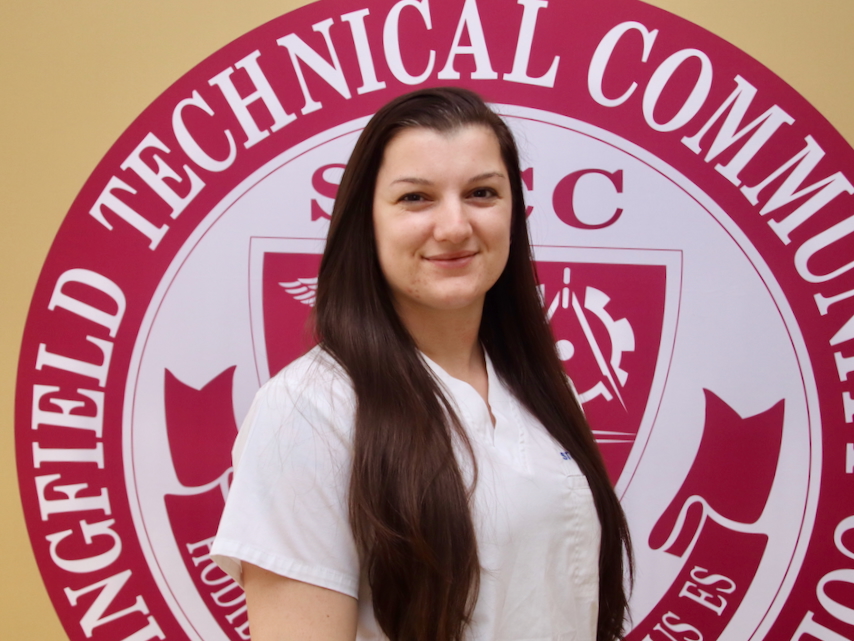
STCC nursing student Carlie Ferry
The experience also sticks.
“If a question comes up while I’m studying, I think back to the Oxford experience, ‘Oh, remember we did this for that patient,’” she said.
In clinical settings, students don’t always encounter high-risk conditions. Virtual reality helps fill that gap.
“Patients don’t have pulmonary embolisms every day,” Ferry said. “So being able to go through that scenario and treat your patient is really helpful.”
For Kay Lopez, a Springfield resident and licensed practical nurse, OMS provides an opportunity to take the lead in ways that real-world training sometimes doesn’t allow.
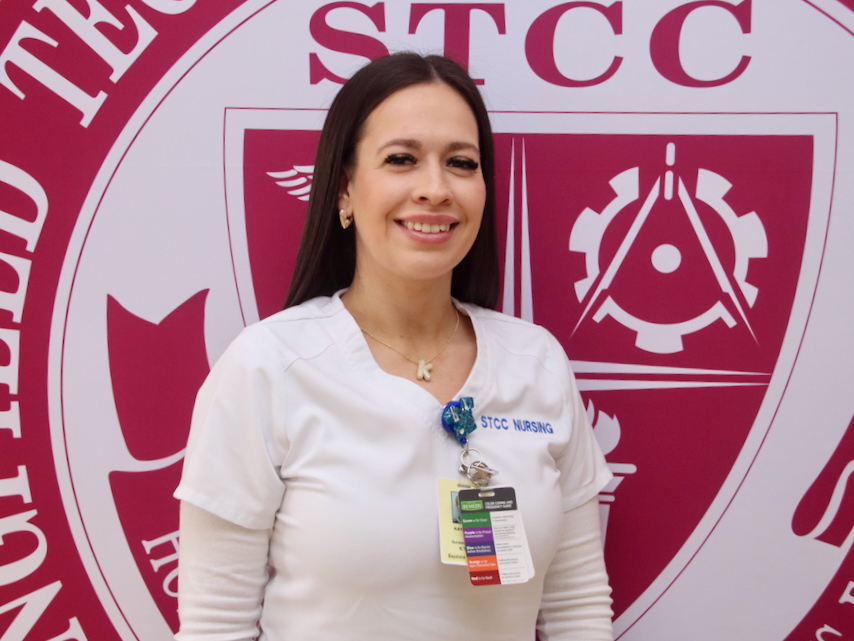
STCC nursing student Kay Lopez
“In a real hospital, if someone has a medical emergency, the rapid response team takes over,” Lopez said. “Here, we get to use our thinking, use the skills we learned and put it all together.”
One of the biggest advantages of virtual reality is the ability to have trial and error.
“It’s OK to make mistakes – it’s a safe place,” Lopez said.
Students can reset scenarios, reflect and try again – building confidence with each attempt.
“At first, it was a little weird because it’s virtual,” Lopez said. “But once you get the hang of it, you learn to navigate as a nurse.”
Ferry has seen that growth firsthand.
“The more you do the scenarios, the easier they become,” she said. “The feedback is extremely helpful. I’ve noticed I get better results the more I practice.”
The simulations are designed to strengthen clinical judgment, especially in urgent situations.
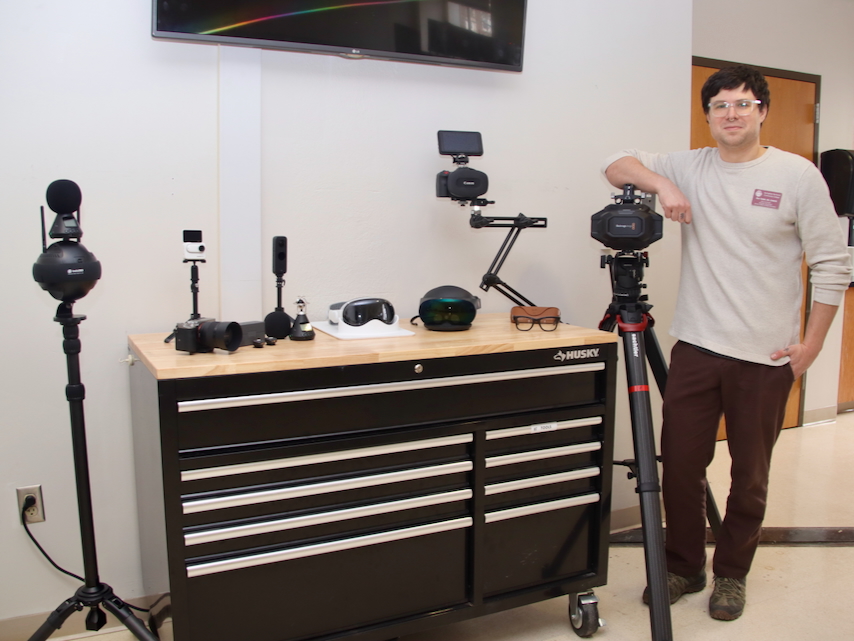
Daniel Taibbi, simulation coordinator, stands next to 'Hollywood level' production equipment used to create the virtual reality experience at STCC.
“You’re developing critical thinking by trying to understand what’s going on with your patient,” Borgos said. “It enhances clinical judgment, prioritization, and rapid decision-making.”
Even in emergency scenarios, students say the environment feels manageable.
“The pressure is less with OMS,” Lopez said. “You’re calmer, even though your patient is experiencing something emergent.”
Behind the scenes, STCC is investing in advanced tools to enhance realism and engagement.
“We have Apple Vision Pro, Meta Quest Pro, and even smart glasses for first-person recording,” said Daniel O’Neill, patient simulation information coordinator. “The idea is using the right tools for the right use cases.”
The college is also using specialized cameras to create immersive content tailored to these devices.
“This is Hollywood-level production equipment,” said Daniel Taibbi, simulation coordinator. “It’s designed to shoot stereoscopic video – one for each eye – so when you put the headset on, you’re getting an experience that feels very close to real life.”
Much of the technology has been supported through grant funding, positioning STCC at the forefront of healthcare education. The nationally-accredited SIMS Medical Center at STCC, one of only a few in the state, features an Innovations Lab with 3D design and printing as well as virtual reality and video experiences.
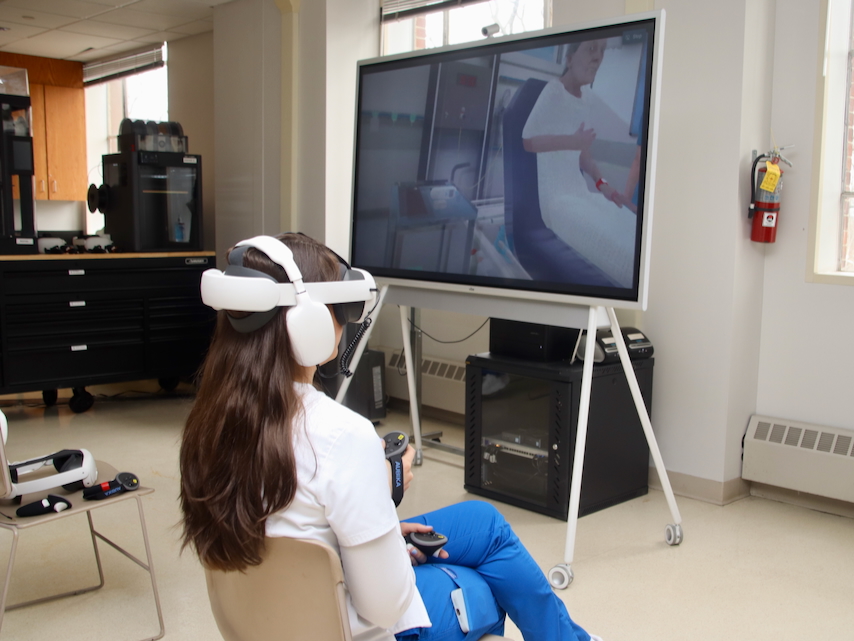
A nursing student wears virtual reality equipment in a classroom.
“This puts us not just on the forefront of educational technology, but truly on the cutting edge,” O’Neill said.
Lisa Fugiel, director of nursing and assistant dean of the School of Health and Patient Simulation, said the approach reflects a commitment to both innovation and patient safety.
“By integrating tools like virtual reality into our curriculum, we’re giving students the opportunity to build confidence and clinical judgment in a way that directly supports patient safety,” Fugiel said. “It’s about preparing them to be ready on day one.”
OMS is just one of the virtual reality experiences. Students in a variety of programs in the School of Health and Patient Simulation put on headsets to immerse themselves in realistic scenarios such as being a patient who is treated by a virtual doctor with poor bedside manner. The experience shows them how to become more empathetic medical professionals.
SIMS Medical Center includes a number of care units with patient simulators that allow students, faculty and providers to conduct medical procedures in real settings. The simulators are life-size, computer-controlled teaching tools that mimic human anatomy and physiology and provide a hands-on, immersive and realistic learning experience. Staff, who are located in an unseen control room, provide a voice for the simulator to interact with students.
For Borgos, a self-described technology enthusiast, the virtual reality element of education is about preparing students for the realities of nursing, especially the moments they can’t always practice in person.
“Students do a lot of clinical hours, but they’re not exposed to everything,” he said. “This is how we bridge that gap.”
For students like Ferry and Lopez, the impact is clear. As they work toward becoming registered nurses, they are gaining experience, confidence and critical thinking skills in a new way.
Interested in applying to STCC? Visit stcc.edu/apply or call Admissions at (413) 755-3333.
About Springfield Technical Community College
STCC, the Commonwealth's only technical community college, continues the pioneering legacy of the Springfield Armory with comprehensive and technical education in manufacturing, STEM, healthcare, business, social services, and the liberal arts. STCC's highly regarded workforce, certificate, degree, and transfer programs are the most affordable in Springfield and provide unequaled opportunity for the vitality of Western Massachusetts. Founded in 1967, the college – a designated Hispanic Serving Institution – seeks to close achievement gaps among students who traditionally face societal barriers. STCC supports students as they transform their lives through intellectual, cultural, and economic engagement while becoming thoughtful, committed and socially responsible graduates.
MEDIA CONTACT:
Jim Danko, (413) 755-4812, jdanko@stcc.edu