
STCC students reach new heights with Engineering Rocket Team
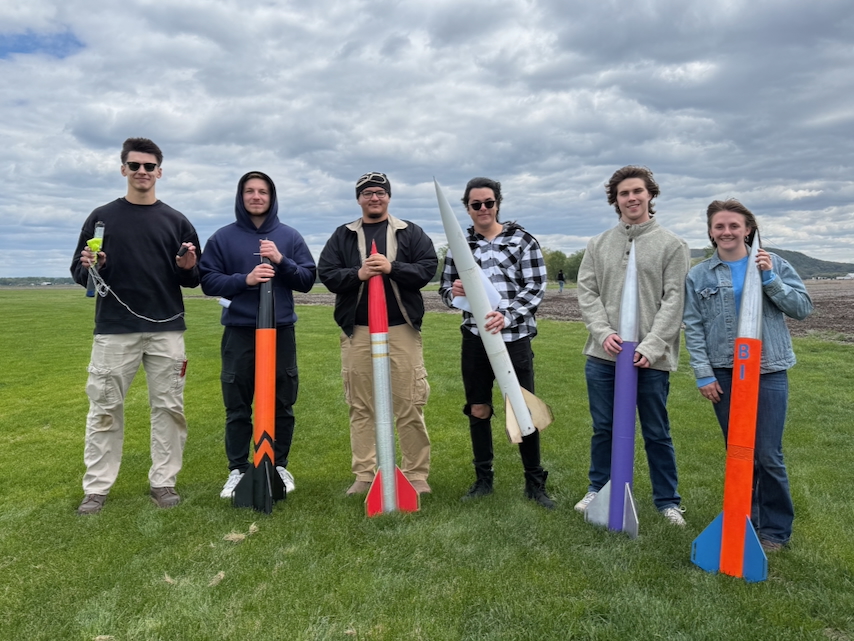
The Engineering Rocket Team prepares for a launch in New York in May 2026.
SPRINGFIELD, Mass. – When Springfield Technical Community College students traveled to a small town in New York to launch rockets more than 1,000 feet into the air, the experience represented more than an exciting weekend competition.
For members of STCC’s new Engineering Rocket Team, the launches symbolized the beginning of a student organization focused on applied engineering at Massachusetts’ only technical community college.
Started during the spring 2026 semester, the Rocket Team gives students experience designing, building, and launching rockets while applying physics, chemistry, and engineering concepts learned in the classroom.
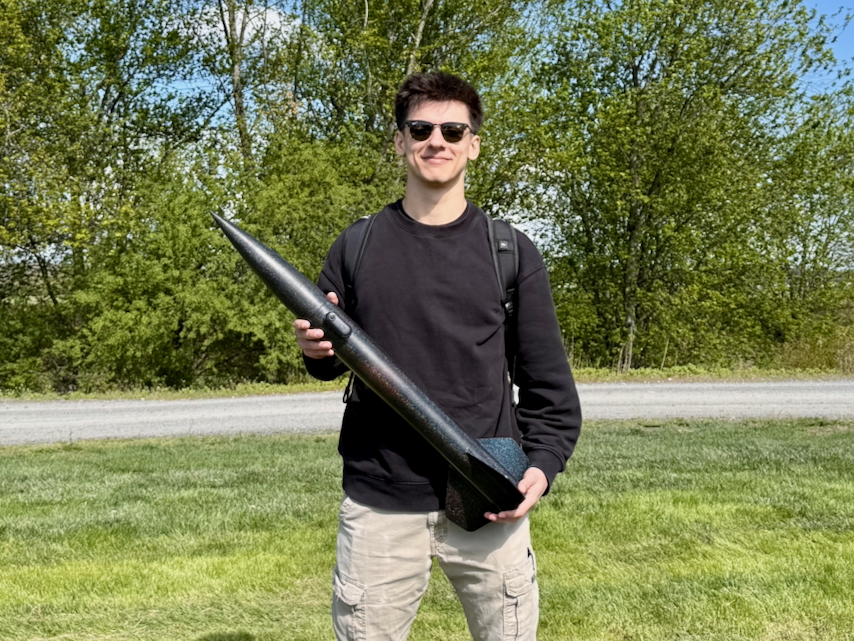
STCC student Vlad Renkas holds his rocket during a launch day in New York.
For Vlad Renkas, a 20-year-old engineering transfer student from Southwick and a co-captain along with student Carter Mack, the team grew out of a personal journey that transformed his future.
Coming out of high school, Renkas described himself as an average student at best. Uncertain about college, he worked landscaping and snowplowing jobs. He grew tired of working outside in the summer heat and then putting in long hours steering a plow during the winter.
He eventually cold-emailed an aerospace machining facility in Connecticut, offering to do any kind of work despite having no technical experience. The company hired him for floor maintenance and basic shop duties.
One day during a lunch break, Renkas encountered a massive aerospace engine component being manufactured for a fighter jet.
“It was so complex, and then it clicked,” he said. “I went home and I kind of got obsessed with propulsion systems.”
That fascination with aerospace engineering eventually led him to STCC through the state’s MassEducate free community college program. Renkas said STCC’s smaller class sizes and dedicated faculty reignited his interest in learning.
He was excited about getting involved outside the classroom and was elected student trustee for the 2026-27 academic year. Renkas also served on the search committee for STCC’s new president, Dr. Jennifer Cournoyer.
The main idea for the rocket team was to give students an ability to strengthen their mechanical aptitudeVlad Renkas, STCC student and co-captain of Rocket Team
He thanked the faculty for inspiring him.
“Professor (Sharon) Sheng has given me so much support,” he said. “It’s not just her. The professors here love their jobs.”
The Engineering Rocket Team emerged after conversations among Renkas, fellow student Carter Mack, alumnus Ryan Laxton ’24 and Professor Sheng, an engineering professor and club advisor.
Professor Jean-Marie Magnier from the Mathematics Department also played a major role in the club’s development, providing students with technical guidance throughout the project. She even launched a rocket alongside students during the weekend competition.
The team also received support from Dr. Miah Dreger, dean of the School of STEM, and Engineering Department Chair Professor Zahid Haddad ‘80.
“As Massachusetts’ only technical community college, STCC is proud to support opportunities like the Rocket Team that allow students to innovate, collaborate, and explore advanced technologies,” Dreger said. “What stands out most is the collaboration between students, faculty, and alumni.”
Haddad said the team helps students strengthen teamwork and problem-solving skills.
“They work together as a group, and they're really enjoying that,” Haddad said. “They learn about forces and friction, and they can discuss that in the classroom.”
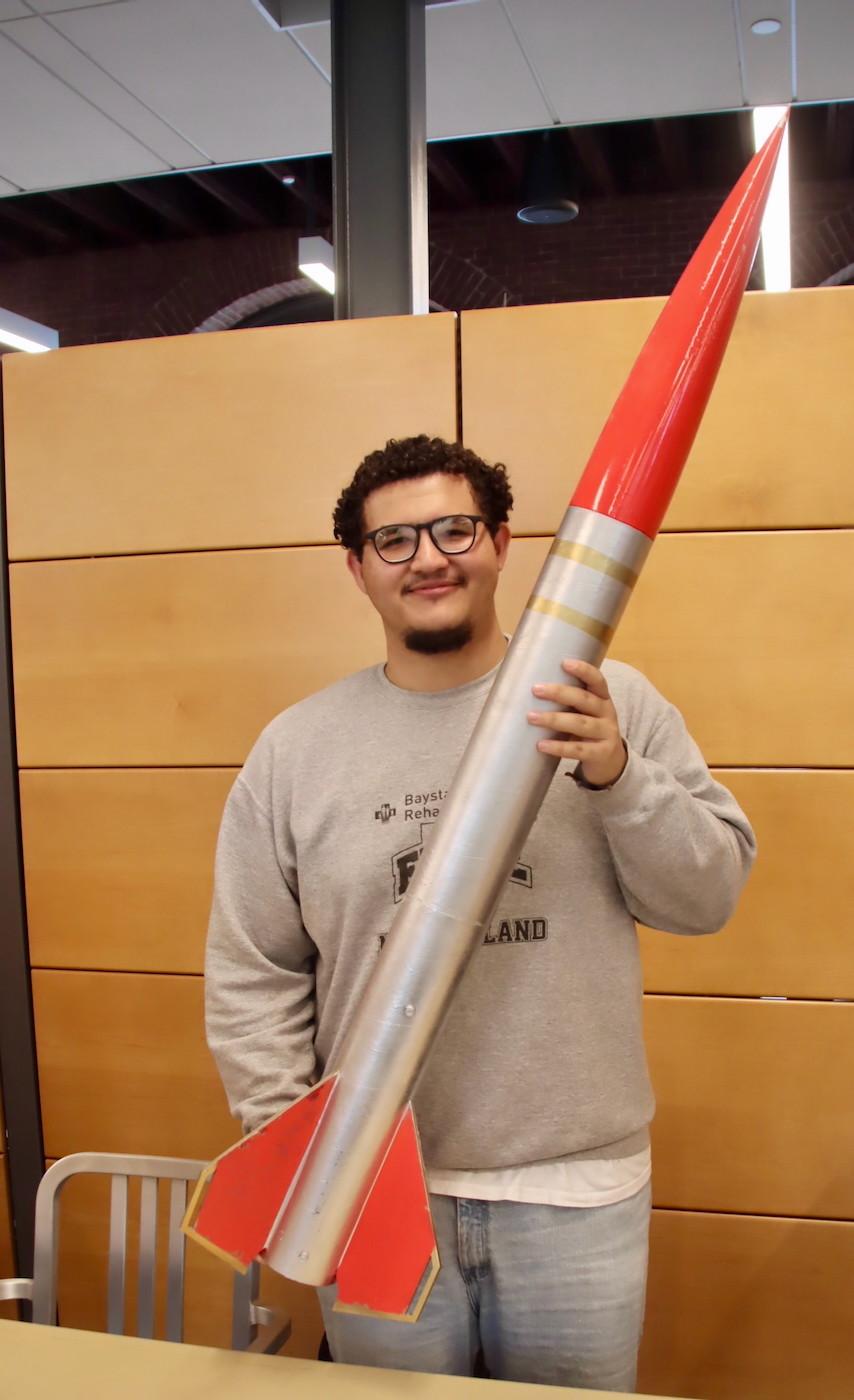
Damien Otero '26 shows his rocket at STCC in May 2026.
Laxton, now studying at Stanford University, became inspired to help start the club after attending a conference where he met members of a community college rocket team from Arizona. He contacted Sheng and suggested a similar organization could become a valuable learning opportunity for STCC students.
On May 3, Laxton’s Stanford rocket team and the STCC team were both conducting launches and engine tests thousands of miles apart.
While STCC students launched rockets in Pine Island, N.Y., Laxton’s team was in California’s Mojave Desert testing rocket engines that fired successfully. Sheng and Laxton exchanged text messages afterward to celebrate the accomplishments.
“Something I’ve realized since being at Stanford University is that engineering clubs provide students with a learning platform that the classroom does not always offer,” Laxton said. “Although I have learned an enormous amount as a Stanford student, I have probably learned twice as much from my work on my rocket team.”
Laxton said he remains deeply connected to STCC.
“I will always look back on STCC as my favorite period of my academic career,” he said. “Stanford has been wonderful, but STCC feels like home.”
The Rocket Team has grown since its inception. As of fall 2026, there are about 20 students from various technical programs.
Members traveled to New York on May 3 to participate in launches sanctioned by the National Association of Rocketry, where students earned certification levels based on successful rocket flights. They plan another launch for November.
After the spring launch, Renkas completed his Level 2 certification while several students earned Level 1 certifications. The rockets, powered by solid motors, reached altitudes of between 1,000 and 2,500 feet before parachutes safely returned them to the ground.
For Damien Otero of Chicopee, an engineering transfer alumnus who graduated in May 2026, the experience was unlike anything he had done before.
“I really thought my rocket was going to explode,” Otero said. “I've never built anything in my life this intricate.”
Instead, his rocket successfully launched approximately 1,500 to 1,700 feet into the air.
“I felt proud because I basically did this – with my hands, I built it,” Otero said.
The launch event also exposed STCC students to teams from larger institutions, including Harvard University and Rochester Institute of Technology.
Renkas said the team’s mission extends beyond launching rockets.
“The main idea for the rocket team was to give students an ability to strengthen their mechanical aptitude,” he said. “You can have as much theoretical knowledge as you want, but you have no idea how to fix mechanical issues. That is something that isn’t really taught. It’s practiced and strengthened.”
For Renkas, who hopes to transfer into aerospace engineering and someday work on propulsion systems, the Rocket Team already demonstrates what is possible at STCC.
“I think anyone can go anywhere from here,” he said. “It doesn’t matter if it’s a four-year college or work. I just want to prepare the students and get them excited about engineering.”
Interested in applying to STCC? Visit stcc.edu/apply or call Admissions at (413) 755-3333.
About Springfield Technical Community College
STCC, the Commonwealth's only technical community college, continues the pioneering legacy of the Springfield Armory with comprehensive and technical education in manufacturing, STEM, healthcare, business, social services, and the liberal arts. STCC's highly regarded workforce, certificate, degree, and transfer programs are the most affordable in Springfield and provide unequaled opportunity for the vitality of Western Massachusetts. Founded in 1967, the college – a designated Hispanic Serving Institution – seeks to close achievement gaps among students who traditionally face societal barriers. STCC supports students as they transform their lives through intellectual, cultural, and economic engagement while becoming thoughtful, committed and socially responsible graduates.
MEDIA CONTACT:
Jim Danko, (413) 755-4812, jdanko@stcc.edu