
Student leader at STCC advocates for Hunger-Free Campus Initiative
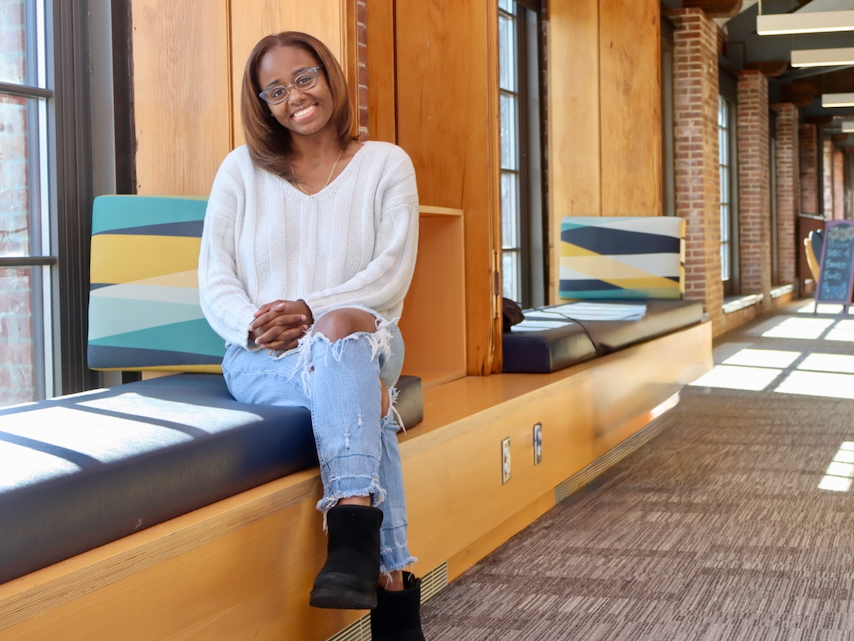
Takira Williams, STCC student and SGA president, sits in the library at STCC.
SPRINGFIELD, Mass. – When Springfield Technical Community College Student Government Association President Takira Williams walked into the Massachusetts State House for the first time, she wasn’t just representing herself.
Williams spoke up for thousands of students who, like her, balance school, work, parenting and everyday responsibilities and who deserve to have their basic needs met.

Takira Williams visits the Massachusetts State House to advocate for the Hunger-Free Campus Initiative.
In November, Williams joined MASSPIRG at the State House to advocate for the Hunger-Free Campus Initiative, a statewide effort aimed at reducing food insecurity among college students. For Williams, a nontraditional student and mother, the experience was both powerful and deeply personal.
“Takira is an exceptional student leader whose passion for equity and student success shines through everything she does,” said Darcey Kemp, Vice President of Student Affairs. “Her advocacy at the State House reflects the strength, resilience and determination of our students. She represents STCC with integrity, compassion and a deep commitment to ensuring all students have the resources they need to succeed.”
Williams didn’t pursue student leadership for the title. She ran for SGA president because she understood firsthand the struggles many STCC students face.
“Being a nontraditional student, I know what it feels like to balance school, work, parenting and real-life responsibilities,” she said. “I didn’t just want to be a student on campus; I wanted to make everyone’s experience amazing and make sure students like me had a voice.”
Her time at STCC has helped her grow into the leader she is today, giving her the confidence and platform to advocate for meaningful change.
“STCC has taught me that leadership isn’t always about providing answers,” she said. “It’s about listening, showing up and using your voice to advocate for others.”
Takira Williams’ personal connection to food insecurity
Food insecurity isn’t an abstract issue for Williams. It’s something she has lived.
“As a mother, there have been numerous times I’ve had to max out my credit card to make sure me and my son had a well-stocked refrigerator,” she said.
On campus, she hears similar stories of many STCC students struggling to find reliable access to food. “You cannot fully show up in a classroom when your stomach is empty,” she said.
Williams acknowledged the important work already happening at STCC to support students facing food insecurity. Through the Center for Access Services (CAS), students can access a wide range of non-academic supports designed to remove barriers and help them stay in school. CAS houses the RAM Mini Mart, a resource that provides free groceries, meals, hygiene products and basic household necessities to eligible students. The Mini Mart offers both in-person shopping and an online ordering system with pickup options, making it easier for students with busy schedules or transportation challenges to access what they need.
Being a nontraditional student, I know what it feels like to balance school, work, parenting and real-life responsibilities. I didn’t just want to be a student on campus; I wanted to make everyone’s experience amazing and make sure students like me had a voiceTakira Williams, SGA president at STCC
CAS also provides school supplies, SNAP application assistance and connections to community agencies to help students navigate financial challenges, homelessness, substance abuse and other difficulties.
While these supports play a crucial role, Williams emphasized that the demand remains high, which is one reason why statewide investment is so essential.
An invitation to advocate
Williams received a personal invitation to the State House from Hannah Rosenkrantz, a UMass Segmental Advisor who recognized her passion and poise. “She thought this would be a great opportunity for me because of my ability to speak well and my passion for advocacy,” Williams said.
Although she arrived feeling both excited and nervous, the day unfolded in a way that exceeded her expectations. Instead of impersonal meetings, she had meaningful conversations with legislators who wanted to understand the student perspective.
“It felt empowering to see that my voice mattered,” she said. “Walking out of those meetings knowing I had advocated for thousands of students back home was an incredible feeling.”
Williams approached lawmakers with a clear message: If Massachusetts provides free meals for students from elementary school through high school, why does that support disappear the moment a student enters college?
“We are products of that system,” she said. “How can we expect students to succeed without guaranteed access to food?”
She emphasized that many community college students support families, hold full-time jobs or navigate financial hardships – all while pursuing their education. A single meal can make the difference between staying enrolled and dropping out.
The Hunger-Free Campus Initiative would help colleges expand pantry access, provide SNAP navigation, support meal programs and increase resources so students never have to choose between food and their education.
For Williams, advocacy is at the heart of her role as SGA president.
“My role … is directly connected to advocacy because it shows my fellow students that I'm not just holding the title but I'm actively using my voice to create change,” she said. “Students feel comfortable coming to me with their stories because they know I’m willing to listen and take action.”
She hopes to continue highlighting the challenges STCC students face, especially those who feel overlooked or unheard.
Beyond her advocacy in Boston, Williams is working on several initiatives to strengthen student engagement at STCC.
One project she’s especially excited about is the SGA podcast, a new tradition designed to amplify student voices and create space for open conversations about leadership, campus life and resources.
“It’s a way for students to feel connected even outside the classroom,” she said.
A message for students: Your voice matters
Williams wants her peers to know that advocacy begins with speaking up.
“Too often, speaking up is considered complaining,” she said. “You’re not complaining. You’re advocating, and that’s the first step to change.”
She hopes her efforts at the State House result in tangible improvements, including expanded food pantry services, better access to affordable meals and stronger support systems across campus.
“My goal is that no STCC student has to sit through class hungry or struggle choosing between food and transportation,” she said.
With graduation approaching in May, Williams plans to stay active in her community and continue advocating for youth. Now studying Business Administration at STCC, she intends to pursue a bachelor’s degree in public policy or political science, with a long-term goal of becoming a juvenile defense attorney.
“I want to advocate for young people not only in the community but within the legal system, where so many voices go unheard,” she said.
If given the chance to return to the State House, Williams knows exactly what she’d champion next: expanding youth-focused support systems, strengthening mental health services and protecting young people in the juvenile justice system.
“I will continue pushing for student-centered issues, like access to basic needs, and support for first-generation and low-income students,” she said.
Interested in applying to STCC? Visit stcc.edu/apply or call Admissions at (413) 755-3333.
About Springfield Technical Community College
STCC, the Commonwealth's only technical community college, continues the pioneering legacy of the Springfield Armory with comprehensive and technical education in manufacturing, STEM, healthcare, business, social services, and the liberal arts. STCC's highly regarded workforce, certificate, degree, and transfer programs are the most affordable in Springfield and provide unequaled opportunity for the vitality of Western Massachusetts. Founded in 1967, the college – a designated Hispanic Serving Institution – seeks to close achievement gaps among students who traditionally face societal barriers. STCC supports students as they transform their lives through intellectual, cultural, and economic engagement while becoming thoughtful, committed and socially responsible graduates.
MEDIA CONTACT:
Jim Danko, jdanko@stcc.edu, (413) 755-4812