
Student support program keeps men’s soccer successful on the field and in the classroom at STCC
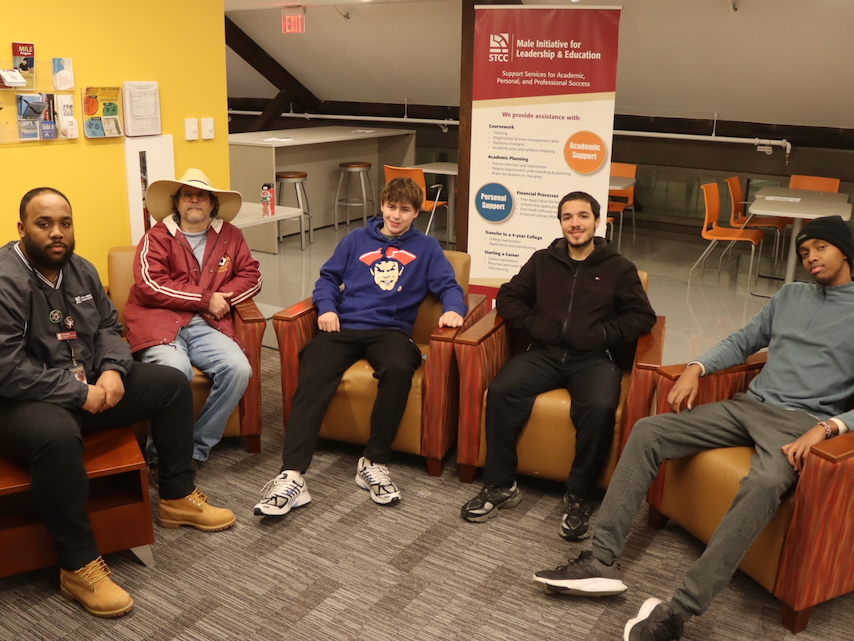
From left: MILE advisor Melvin Tejada, men's soccer coach William Sweidel, STCC students and soccer players Jacob Melvin, Isaias Bernard and Vincent Githiri.
SPRINGFIELD, Mass. – For Coach William Sweidel, the defining moment of the men’s soccer season at Springfield Technical Community College didn’t come from a single goal, win or playoff result. Instead, it came from a realization.
“I think this kind of experience,” Sweidel said, gesturing toward the table where he sat alongside MILE advisor Melvin Tejada and three of his team captains, “is the defining moment.”
After 13 years at STCC, Sweidel saw something take shape this season that had never existed before: a deep, intentional collaboration between Athletics and the Male Initiative for Leadership and Education (MILE) program. The result was not only one of the most successful seasons on the field, but also what is expected to be the highest student-athlete retention rate the program has ever seen.
“Something’s coalescing,” Sweidel said. “Our partnership with MILE is helping retention 100 percent.”
MILE is a program designed to provide inclusive academic support, mentoring, and community engagement opportunities to male students at STCC. Student participants connect with professionals who will serve as mentors throughout the student’s time at the college.
The men’s soccer team reached the semifinals of the Region XXI tournament for the first time under the current nine-team format. Along the way, the team defeated Community College of Rhode Island in overtime in the quarterfinals and narrowly lost, 4-3, to the eventual tournament champions.
Earlier in the season, the team also recorded a landmark victory over Bunker Hill Community College, a win Sweidel believes may have been the first in decades.
“We were respected by all the teams and the coaches,” Sweidel said. “To hear congratulations and compliments about our sportsmanship and level of play, from coaches I respect, that meant a lot.”
But what stood out even more was what happened after the season ended.
“They’re staying around,” Sweidel said. “They’re training now. We’re going to train as a team in the spring. I’ve never had 12 or 13 players training in the spring. That’s unheard of.”
At the center of that commitment are the team’s three captains: Isaias Bernard of Springfield, Jacob Melvin of West Springfield, and Vincent Githiri of Springfield. They are all participants in the MILE program, like most of the team.
“What’s most meaningful is the relationships I have with the three captains,” Sweidel said. “They’re filled with humility. They’re kind. They’re generous. They’ve set the standard for the future.”
Our partnership with MILE is helping retention 100 percent.William Sweidel, STCC soccer coach
For Githiri, being named captain was the fulfillment of a long-held goal.
“Being team captain was always my dream,” said Githiri, a biology transfer student. “You set the tone at practice and at every game. It helps you grow as a person because you have to articulate the right words to get the best results.”
Githiri pointed to the early-season win over Bunker Hill as a personal and collective high point, along with a strong performance against Northern Essex Community College, a team that had lost just once during the regular season.
“That game showed us we could play against the best,” he said. “That belief carried us into the playoffs.”
For many players, the MILE office on the third floor of the Student Learning Commons (Building 19) became the team’s second home.
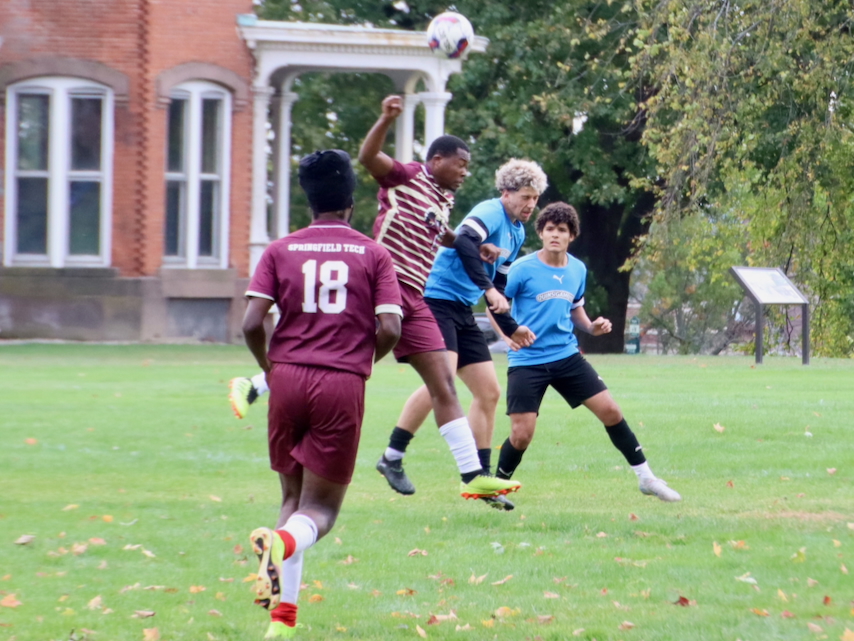
The STCC men's soccer team plays Quinsigamond Community College in an Oct. 14 match at STCC.
“Just having the space here to do your work helped me a lot,” said Bernard, a general studies major. “It’s hard to focus when you’re juggling life, school and soccer. Being here brought us closer. We had genuine conversations and built stronger relationships.”
Melvin, who is studying laser optics, said MILE also became a place for team bonding and growth beyond academics.
“We watched game film together here,” Melvin said. “We talked, got to know each other, and learned how to lead different teammates in different ways.”
Melvin Tejada, academic and transfer counselor in the MILE program, said the team’s success began with a clear message from the start of the season.
“If you’re not focused on academics, the field is going to be far from you,” Tejada said. “Soccer is important, but academics are the driving force here.”
Tejada saw players spending free time in the MILE office studying together, checking in and asking questions – something he believes made all the difference.
“One of my biggest sayings is, ‘Closed mouths don’t get fed,’” he said. “These guys ask questions. They reach out. They know we’re here to support them.”
That support went beyond course planning and eligibility checks. Tejada emphasized mentoring, one-on-one conversations and simply being available during stressful stretches of the season.
“Sometimes that quick check-in is all it takes,” he said. “These guys are full-time students, athletes, workers and people with lives outside of school. Our job is to help alleviate some of that pressure before it becomes overwhelming.”
Several players spoke about learning when to say no to activities that might interfere with their academics. They wanted to keep their focus on school work.
“Coach was really pushing us to be great,” Bernard said.
Melvin echoed that sentiment, noting that Sweidel consistently emphasized life after soccer.
“Coach made sure my career was the number one priority,” Melvin said. “He didn’t want me coming here just to play soccer. He wanted me here for my future.”
That philosophy shaped Sweidel’s recruiting approach as well. This year, he focused on understanding each recruit’s academic interests and career goals, often meeting multiple times with prospective players.
“We have fire science majors, cybersecurity, IT, biology, laser optics,” Sweidel said. “I track it. Melvin (Tejada) tracks it. We communicate.”
Vice President of Student Affairs Darcey Kemp said the men’s soccer team’s experience this season reflects the kind of holistic student support STCC strives to provide.
“What we’re seeing with men’s soccer is exactly what happens when academic support, student engagement, and athletics work together intentionally,” Kemp said. “The partnership between Coach Sweidel and the MILE program demonstrates how strong relationships and consistent mentoring can positively impact retention, leadership development, and student success.”
With most of the roster expected to return, the team is entering next season with unprecedented continuity and ambitious goals.
“We want to win the regional championship,” Githiri said. “We want to make our first appearance in nationals in a very long time.”
Sweidel believes that foundation, which was built through leadership, academic support and meaningful relationships, has changed the program for good.
“These players have changed the recruiting process,” he said. “When you join this team now, you’re joining a family. The groundwork has been laid.”
For Tejada, the season serves as a powerful example of why athletics matter.
“They can look back and say, ‘I was part of something special here,’” he said.
Interested in applying to STCC? Visit stcc.edu/apply or call Admissions at (413) 755-3333.
About Springfield Technical Community College
STCC, the Commonwealth's only technical community college, continues the pioneering legacy of the Springfield Armory with comprehensive and technical education in manufacturing, STEM, healthcare, business, social services, and the liberal arts. STCC's highly regarded workforce, certificate, degree, and transfer programs are the most affordable in Springfield and provide unequaled opportunity for the vitality of Western Massachusetts. Founded in 1967, the college – a designated Hispanic Serving Institution – seeks to close achievement gaps among students who traditionally face societal barriers. STCC supports students as they transform their lives through intellectual, cultural, and economic engagement while becoming thoughtful, committed and socially responsible graduates.
MEDIA CONTACT:
Jim Danko, (413) 755-4812, jdanko@stcc.edu